
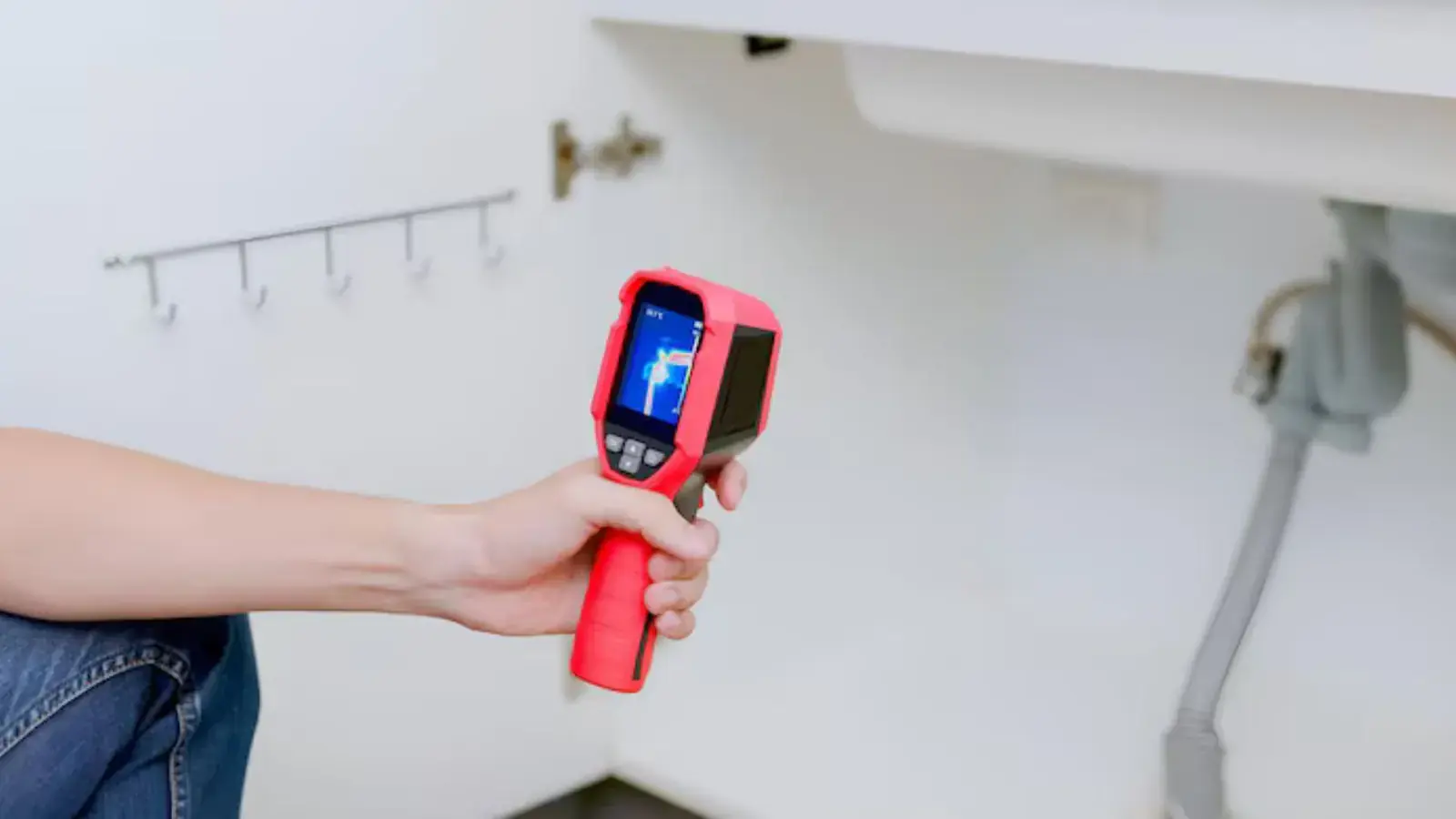
A thermal camera shows a picture of surface temperature. A wet wall, a warm patch of floor above a hot water line or a cold spot from evaporating water all show up as color differences. For a plumber hunting a hidden leak, that picture shrinks the search from a whole room to a few square feet.
This guide explains what infrared imaging does well, where it can mislead you and how it fits with moisture meters, acoustic listening and pressure tests. If you have a suspected leak, the leak detection page explains the full process, and the line is open 24/7 for active leaks.
What a thermal camera can show
Findings and what they suggest
A thermal image points to a place to look. It does not by itself prove that water is leaking there.
| Image shows | What it may mean | Confirm with. |
|---|---|---|
| Warm stripe on a floor | Hot water line leaking or running beneath | Pressure test and acoustic tools. |
| Cool patch on a wall or ceiling | Evaporating moisture | Moisture meter. |
| Pattern along a pipe route | Wet insulation or a leak along the run | Visual check, camera or pressure test. |
| Warm or cool spot outdoors | Underground line | Acoustic listening and tracing. |
Where infrared falls short
- It sees surface temperature only, so deep leaks under thick concrete may not show.
- Sun, vents, appliances and windows create temperature differences that look like leaks.
- Cold supply lines have little temperature contrast, so they are harder to find than hot lines.
- A leak that has stopped can leave a cool patch for a while, which can mislead.
This is why plumbers do not rely on a camera alone. The camera narrows the area, and a moisture meter and a pressure test confirm the leak is real.
How infrared works with other tools
A typical leak hunt
The tools are used in a sensible order.
- 1
Check the meter. With everything off, a moving meter means a leak somewhere on the property.
- 2
Isolate the system. Hot and cold lines, the outdoor line and the irrigation are separated and tested.
- 3
Scan with infrared. Walls, ceilings and floors are scanned for temperature anomalies.
- 4
Confirm with a moisture meter. Suspect spots are checked for actual moisture.
- 5
Listen and trace. Acoustic tools pinpoint the sound of water escaping, and the repair spot is marked.
For leaks under concrete, see slab leak repair. Those leaks combine thermal imaging with listening equipment, because concrete hides much of the signal.
Should you buy a thermal camera yourself
Consumer thermal cameras and phone attachments exist, and they can be useful for spotting a cold patch or missing insulation. They are less useful for finding a leak, because interpreting the image takes practice, and a false alarm leads to opening a wall for no reason.
If you want to try one, treat the image as a clue and not a verdict. Mark the area, run the meter test and call a plumber to confirm before cutting into anything.
What to expect during a visit
A leak detection visit starts with questions. When did the bill change, where is the damp spot, what is the water heater doing, and is there a sprinkler or pool on the property. The meter test follows, then the scan. Furniture near the suspect area may need to be moved so the camera can see the wall or floor.
You should get a plain report of where the leak is, how confident the plumber is and what the repair involves. That report also helps with an insurance claim.
What affects the cost of leak detection
A clear price comes before work starts.
What the camera cannot tell you
An infrared camera shows temperature differences, not water. A cool patch on a wall might be a leak, or it might be an uninsulated stud bay or an air vent. That is why the reading is confirmed with a moisture meter and, where needed, a pressure test.
Treat a thermal image as a clue that points to where to test next, not as a finished diagnosis.
Douglasville: clay soil and hidden leaks
Douglas County is on the Georgia Piedmont, where clay soil swells when wet and shrinks when dry. That movement stresses pipe joints and can open small leaks, and a leak in clay can saturate the soil around a pipe before it shows at the surface.
If a leak is in the line between the meter and the house, the Douglasville-Douglas County Water and Sewer Authority can tell you where its responsibility ends. Underground water service lines are also a fee item on Douglas County's residential plumbing permit application, so ask the county building department about a repair. Homes in Lithia Springs follow the same county rules.
Georgia's state minimum plumbing code is the International Plumbing Code (IPC) with Georgia amendments, enforced locally. It recognizes pressure testing, so expect a plumber to confirm a camera finding with a test.
Suspect a hidden leak? Call and we find it before we open anything.
Frequently asked questions
It can show a temperature difference on the wall surface, which is a clue. A moisture meter and other tools confirm it.
Sometimes, especially for hot water lines. Concrete hides much of the signal, so acoustic tools are used as well.
Sun, vents, windows and appliances create temperature differences that look like moisture.
They do different jobs. Infrared scans a wide area quickly, and a meter confirms moisture at a spot.
The line is open 24/7 for active leaks. Scheduled detection visits are by appointment.
Some policies cover the cost of finding a leak that caused covered damage. Read your policy and ask your insurer.
Leak detection visits are dispatched to Lithia Springs and to the towns on the service areas page.