
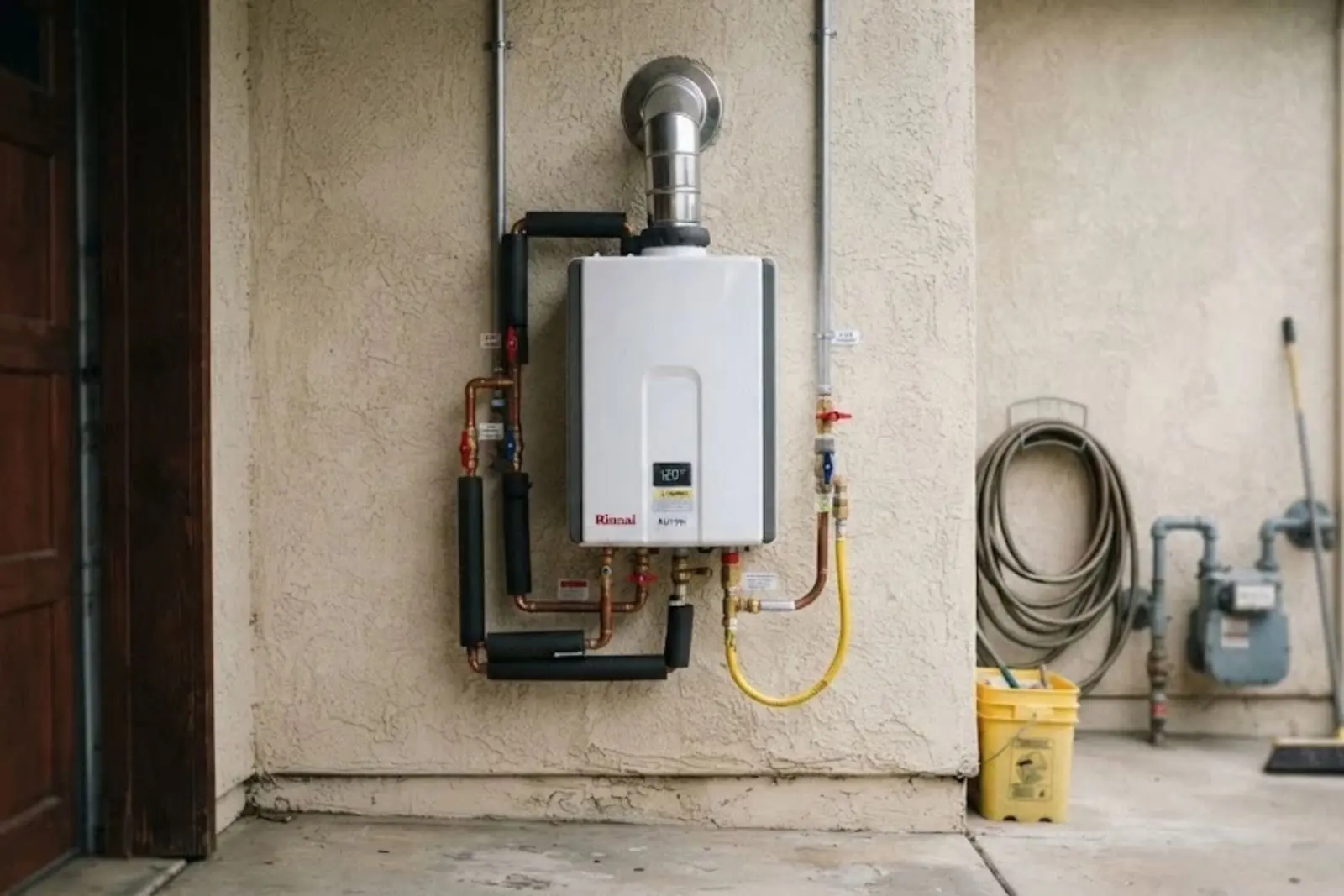
A tankless water heater heats water on demand instead of keeping a tank hot all day. That means no standby heat loss, a compact wall unit and a supply that lasts as long as the heater can keep up. It also means the unit has to deliver a lot of heat quickly, and the house has to supply it.
This guide is for homeowners deciding between a tank and a tankless unit. It covers how to size one, what a typical install needs, the maintenance that keeps it healthy and when a tank is the better answer. For the service details, see our tankless water heater page.
How tankless sizing works
A tankless unit is rated by flow, in gallons per minute, at a certain temperature rise. Temperature rise is the difference between the incoming water and the hot water you want. In cooler months, incoming water is colder, so the same unit delivers less flow.
Add up your peak demand
These are rough values. Add the fixtures that run at the same time in your busiest hour, and compare the total with the unit's rated flow at your temperature rise.
| Fixture | Typical flow. |
|---|---|
| Shower | 2 gallons per minute. |
| Bathroom sink | 0.5 to 1 gallon per minute. |
| Kitchen sink | 1.5 to 2 gallons per minute. |
| Dishwasher | 1 to 2 gallons per minute. |
| Washing machine | 2 gallons per minute. |
What the house has to provide
- A gas line large enough for the unit's input rating, which is often larger than a tank heater needs.
- Venting that meets the maker's rules, often stainless or approved plastic through a wall or roof.
- A condensate drain for high-efficiency units.
- Electricity for the controls and fan, and a heavy circuit for electric units.
- Water supply with isolation valves so the unit can be flushed.
Electric tankless units draw a lot of power, and some houses need a service upgrade to run one. A plumber and an electrician look at the panel first.
Gas or electric
Comparing fuels
| Type | Strengths | Trade-offs. |
|---|---|---|
| Gas tankless | High flow, common in houses with gas | Needs venting and a larger gas line. |
| Electric tankless | No venting, compact | High electrical load, lower flow per unit. |
| Tank, for comparison | Low purchase cost, simple | Standby heat loss, finite supply. |
Maintenance
Minerals scale up the heat exchanger over time. A yearly flush with a descaling solution keeps the passages clear, and the inlet screen should be cleaned at the same time. Units without service valves need them added. Skipping maintenance is the main reason tankless units fail early.
Keep the manual and the install paperwork. Warranty terms for tankless units often require maintenance records.
When a tank is the better choice
A tank is often better where the budget is tight, where the gas line or vent would be costly to change, or where the house is small with modest demand. A tank can also make sense when you need hot water back fast after a failure. Our water heater installation page explains both options.
If your current heater has failed and the floor is wet, see water heater replacement, because speed matters more than design in that moment.
Questions to ask before you buy
- What is the unit's rated flow at my winter temperature rise?
- Is my gas line sized for the input rating, or does it need replacing?
- Where will the vent run, and does the route meet the maker's rules?
- Does the unit have service valves for flushing?
- What does the warranty require for maintenance records?
A plumber who answers these in writing is showing the work a good install needs. A quote that skips them often hides a gas line or vent cost that turns up later.
Recirculation and wait times
Tankless units do not shorten the wait for hot water at a far fixture. The pipe between the heater and the faucet still has to clear of cool water first. Some houses add a recirculation pump or a small buffer tank to cut that wait.
If your complaint today is a long wait and not a lack of hot water, a tankless unit alone will not fix it. Say so when you ask for a quote, so the design deals with the real problem.
What to expect on install day
Swapping a tank for a tankless unit is a larger job than swapping one tank for another. Expect gas line work, a new vent, a condensate line and new water connections. Plan for the water to be off for part of the day, and for the old tank to be hauled away.
Douglasville: gas lines, permits and water
Douglas County's residential plumbing permit application lists water heaters and gas lines as fee items, with gas line work priced by the foot. Moving to tankless often changes the gas line, so call the county building department at the planning stage.
The Douglasville-Douglas County Water and Sewer Authority's 2026 water quality report does not list hardness. A tap test tells you how aggressive your maintenance schedule needs to be. Homes in Lithia Springs and the towns on our service areas page should check their own utilities.
Georgia's state minimum plumbing code is the International Plumbing Code (IPC) with Georgia amendments, enforced locally. Water connections and relief devices fall under it, while gas and venting follow their own rules and the maker's instructions.
Thinking about tankless? Call for a plumber and a clear price.
Frequently asked questions
Add the flow of the fixtures you run at once, find your winter temperature rise and choose a unit rated above that at your conditions.
Often yes, because their input rating is higher than a tank's. A plumber measures the existing line.
Yes. A yearly flush and inlet screen cleaning are the usual baseline, and more often in scale-prone water.
It avoids standby loss, but the higher purchase and install cost can take years to offset. It depends on your use.
Many last around 20 years with maintenance.
Yes. We dispatch for tankless installs and service. Call for a survey and a clear price.
Yes, surveys and installs are dispatched to Lithia Springs. The service areas page lists the other towns.