Replacing a heating element is a common fix for an electric water heater. When the water is still cold afterward, it is frustrating, and the cause is usually something the new element depends on. The element is the last link in a chain that starts at the breaker.
This guide walks that chain in order. It is for homeowners who want to understand what a plumber will check. It is not an invitation to work on live 240 volt wiring. If you are not trained for that, call, and the line is open 24/7. If there is any water leaking, close the cold supply and turn off power at the breaker first.
Start with the simplest causes
Checks in order
Each one rules out a part of the chain.
- 1
Is the tank full? An element energized in an empty tank burns out within seconds. Open a hot tap and confirm water flows and air is purged.
- 2
Is the breaker on? Check that the dedicated breaker is not tripped and is fully reset.
- 3
Is the high-limit reset tripped? Most upper thermostats have a red reset button. Press it once, with the power off, and then restore power.
- 4
Is the access panel back in place? Insulation and covers must be replaced after the job, and wiring must not be pinched.
- 5
Is the thermostat set above the water temperature? A thermostat set too low will not call for heat.
The thermostat chain
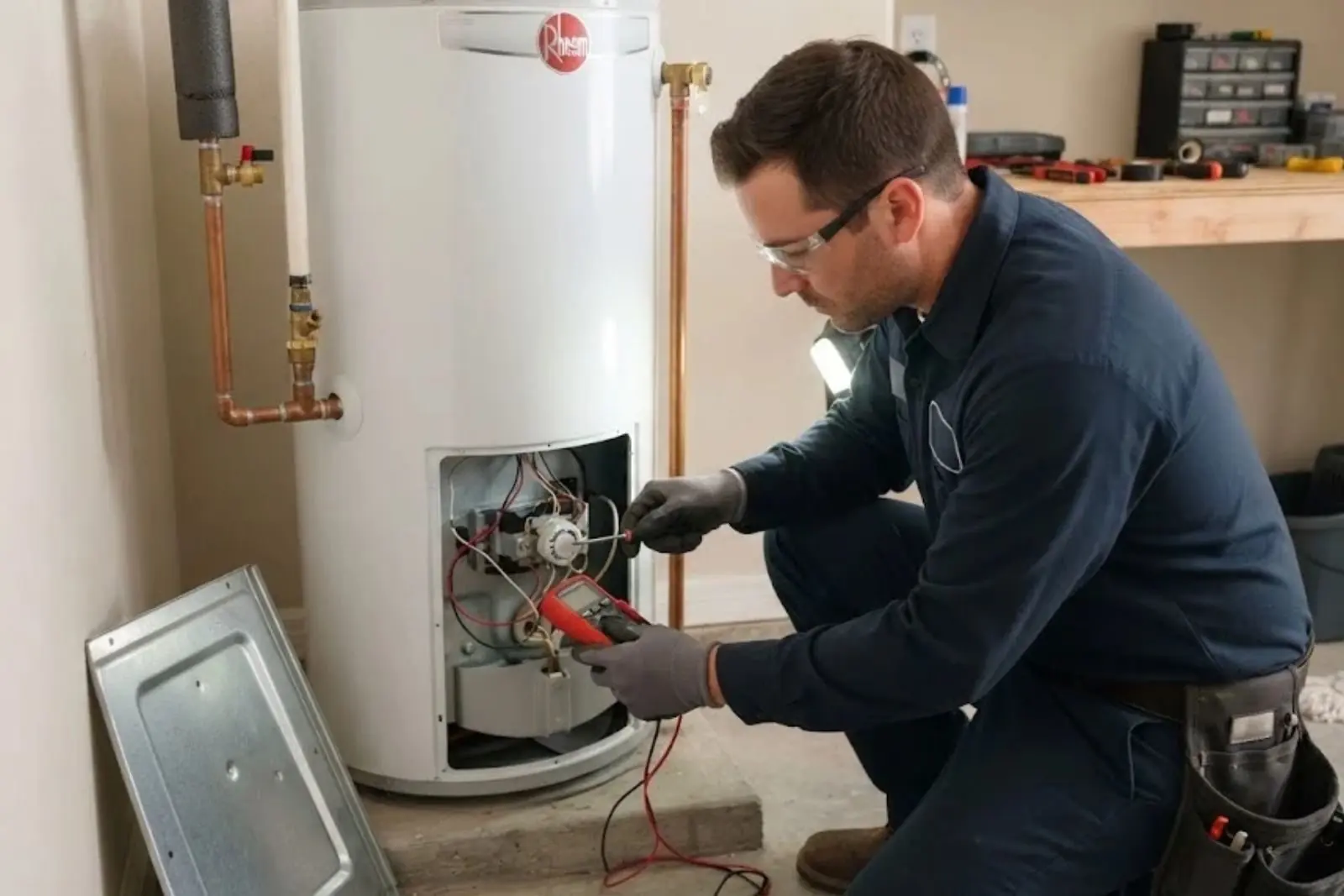
Electric water heaters usually have two thermostats, one for the upper element and one for the lower. The upper thermostat gets power first and controls both elements, because the lower one only heats after the upper one is satisfied. If the upper thermostat or its high-limit switch is bad, nothing heats.
This is the most common reason a new element does not fix a cold heater. A plumber tests the thermostats with a meter, and replaces a bad one, which is a small and inexpensive part.
Symptoms after an element swap
| What happens | Likely cause | Next step. |
|---|---|---|
| No heat at all | Upper thermostat or high-limit reset | Test and replace the thermostat. |
| Only lukewarm water | Wrong wattage, one element not heating, or a failed lower thermostat | Test each element and thermostat. |
| Breaker trips | Short in an element or wiring | Power off and call a plumber or electrician. |
| Hot water runs out fast | Lower element or dip tube problem | Test the lower element and inspect the dip tube. |
| Water is hot, then cold | Sediment, or a failing thermostat | Flush the tank and test. |
Wiring and connection problems
A loose wire nut, a wire touching the tank or a burned terminal can stop an element from heating. The heater's wiring diagram is on a label inside the panel, and a plumber follows it. Scorched insulation or discolored terminals are signs of a poor connection, and they should be repaired before power is restored.
Wattage matters too. An element with the wrong wattage for the heater can trip protective devices, and it is a safety issue as well as a performance one.
When the tank is the problem
A heavy layer of sediment can bury the lower element and keep water from heating. A tank with a deep layer of scale may need a flush, and a tank that is old or leaking may be at the end of its life. Where the tank is failing, water heater replacement is the sound choice, and the water heater repair page explains how we decide.
If the heater is more than ten years old and has needed several repairs, compare the cost of the next repair with a new unit.
When to stop and call a plumber
Some signs mean you should stop troubleshooting. A breaker that trips again as soon as you reset it points to a short. A burning smell, scorched wiring or a hot panel are reasons to cut power and leave the heater alone.
- The breaker trips immediately after reset.
- You see melted insulation or discolored terminals.
- Water leaks from the element gasket after refilling.
- The tank makes loud popping or rumbling sounds.
- The heater is old and has failed more than once.
Each of these needs a meter and a trained eye. A plumber can test the circuit safely, and an electrician can check the supply side if the fault is upstream of the heater.
Keeping the new element alive
A new element lasts longer in a tank that is flushed on a schedule. Draining a few gallons from the bottom once a year removes loose sediment before it hardens around the lower element. Set the thermostat no higher than you need, since very hot water scales elements faster.
What to do if the heater stays cold
- Turn off the breaker before opening any panel.
- Do not reset a tripping breaker again and again.
- Do not touch scorched wiring or damp insulation.
- Close the water supply if anything is leaking.
- Call a licensed plumber or electrician.
Douglasville: sediment, water and permits
The Douglasville-Douglas County Water and Sewer Authority treats Dog River Reservoir water at its Bear Creek plant. Its 2026 report does not list hardness, so test your tap. Sediment and scale build up in any tank, and a yearly flush keeps the lower element from being buried.
Douglas County's residential plumbing permit application lists water heaters as a fee item, so ask the county building department if a swap needs a permit. Lithia Springs homeowners use the same county office.
Georgia's state minimum plumbing code is the International Plumbing Code (IPC) with Georgia amendments, enforced locally. A tank that needs replacement is expected to meet it, including relief valve discharge.
Still no hot water after new elements? Call and a plumber is dispatched.
Frequently asked questions
The thermostat, the high-limit reset, the wiring or the breaker is the usual cause. The new element depends on all of them.
It is on the upper thermostat behind the access panel. Turn the power off first, press it once and restore power.
Yes. A wrong wattage or style can cause trouble. Check the label on the heater and match it.
The tank probably was not full when power came on. Elements need to be underwater.
Only if you are trained for 240 volt work. Otherwise call a licensed plumber or electrician.
Yes. The line is open 24/7 and a licensed plumber can be dispatched.
Yes. A licensed plumber can be dispatched to Lithia Springs. Other towns are on the service areas page.