
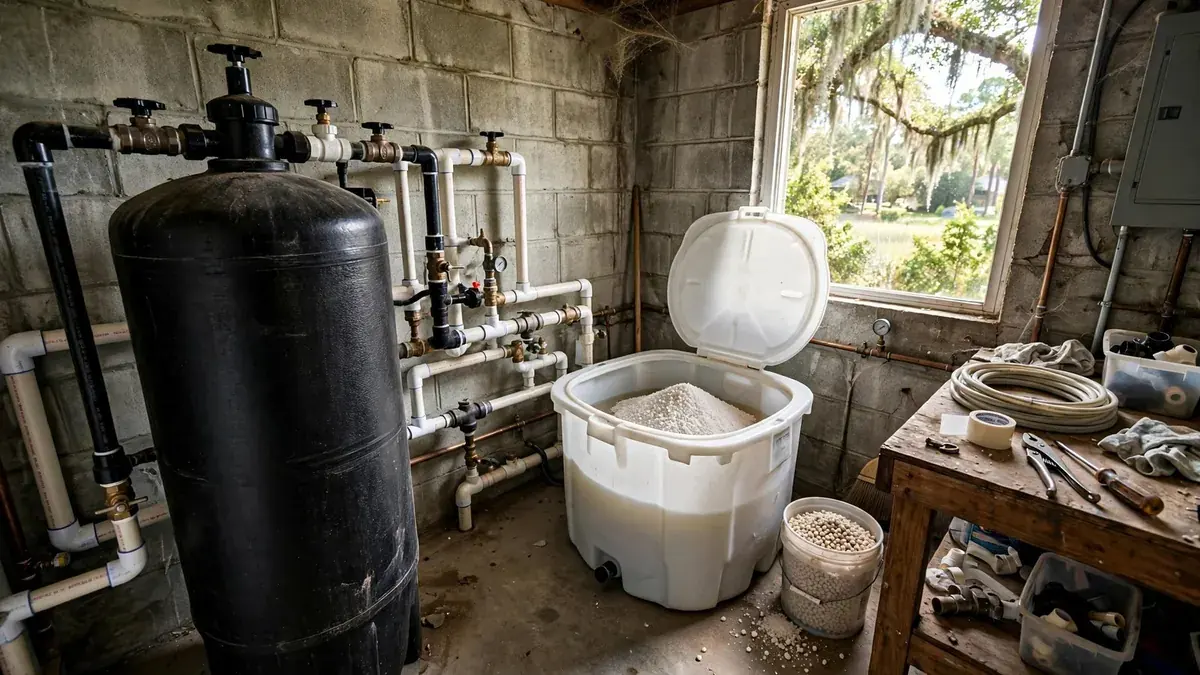
A water softener swaps hardness minerals for sodium or potassium from the brine tank. When the brine tank forms a hard crust of salt, called a bridge, the salt above stays dry and the salt below drops away. The softener keeps cycling, but it has no brine to make, so the water goes back to hard.
This guide explains how to spot a salt bridge, how to break one safely and how to stop it from forming again. Water softener work is not a separate page on this site, so this is a practical homeowner guide, with a plumber's help for anything that touches the plumbing.
Signs of a salt bridge
- Hard water signs return: spots on glass, scale on fixtures, dry skin after a shower.
- The brine tank looks full, but the salt level never seems to drop.
- The softener's salt level light or app shows no change after regenerations.
- There is no water in the brine tank, or it never fills to the usual level.
A related problem is a salt mush, where salt dissolves and recrystallizes at the bottom into a sludge. Both reduce brine production, and both can be handled the same way.
How to check for a bridge
A quick check
You need a broom handle or a long wooden dowel, and a few minutes.
- 1
Open the brine tank. Remove the lid and look at the salt. A crust on top that looks solid is a warning sign.
- 2
Probe the salt. Push a broom handle down gently into the salt. If it hits a hard surface above the water line, there is a bridge.
- 3
Look for a gap. If there is empty space under the crust, the bridge is confirmed.
- 4
Check the water. Water should be visible at the bottom. If there is none, the brine system may need service.
- 5
Break it carefully. Tap the crust to break it into pieces, pushing the pieces down. Avoid striking the tank or the float and well.
Why bridges form
Cause and prevention
| Cause | Why it happens | Prevention. |
|---|---|---|
| Humidity | Moist air dissolves the salt surface, which dries and hardens | Keep the lid on and keep the area ventilated. |
| Overfilling | Salt packed above the water line forms a crust | Fill to about halfway or as the maker advises. |
| Low-quality salt | Some salt types contain impurities and cake | Use the grade your softener's manual names. |
| Temperature swings | Condensation forms and refreezes or dries | Keep the softener in a stable area. |
| Low usage | Salt sits unused for long periods | Check the tank on a schedule and do not top up on top of old salt. |
After you break it
Dissolve any remaining chunks by adding warm water to the tank, let it sit, and then run a manual regeneration according to the softener's manual. Wait a few hours and check the water at a tap with a hardness test strip.
If the brine tank is full of sludge, scoop out the salt, rinse the tank and refill with fresh salt. This is also a good time to look at the float, the brine well and the tubing.
When it is more than a salt bridge
A softener that still makes hard water after the bridge is gone may have other faults. The cause can be a control valve problem, a clogged injector, a worn resin bed or a bypass valve in the wrong position. A plumber can check the plumbing connections, the bypass and the drain line. A leak or a drain overflow near the softener is a reason to call for leak detection or a repair of the connections.
Installing a softener involves a drain connection, a bypass and supply fittings, and the plumbing installation page explains our approach to planned work.
Habits that prevent bridges
- Keep the salt level at or below half the tank height and refill before it empties.
- Use the salt type the maker recommends.
- Store salt bags dry and avoid opening them in damp rooms.
- Check the tank every month and break up crusts early.
These habits cost minutes. A bridge that is left for months can leave the house with unsoftened water while the unit seems to run normally.
Douglasville: confirm your hardness before you adjust anything
The Douglasville-Douglas County Water and Sewer Authority's 2026 water quality report does not list a hardness figure, so the only reliable number is the one from your own tap. A test strip costs little, and it tells you whether the softener is working and how it should be set.
Douglas County's residential plumbing permit application lists many fixtures and connections, and the county building department is the place to ask whether a softener install or move needs a permit. The same guidance applies in Lithia Springs and the towns on our service areas page.
Georgia's state minimum plumbing code is the International Plumbing Code (IPC) with Georgia amendments, enforced locally. Drain connections for treatment equipment are expected to protect against backflow, so keep the air gap intact.
Softener plumbing leaking or not draining? Call for a plumber.
Frequently asked questions
It is a hard crust that forms in the brine tank and leaves an empty gap below, so no brine is made.
Probe the salt with a broom handle. If you hit a hard layer above an empty space or water line, it is a bridge.
Avoid overfilling, keep the lid closed, use the right salt grade and check the tank regularly.
Yes, if you do it carefully with a wooden handle and avoid hitting the tank or float. Do not use sharp metal tools.
Check the bypass valve, the control settings and the resin bed, and test the water with a strip. A plumber can help with the connections.
The water authority's 2026 report does not list a hardness figure, so test your own tap.
Softener faults are the same anywhere, but the water source can differ by address. Read the notes for Lithia Springs and see the service areas page for other towns.